

Aid is dead. Now let's talk.
What the North can let go of. What we can let go of. And what we have already started to build.

I.
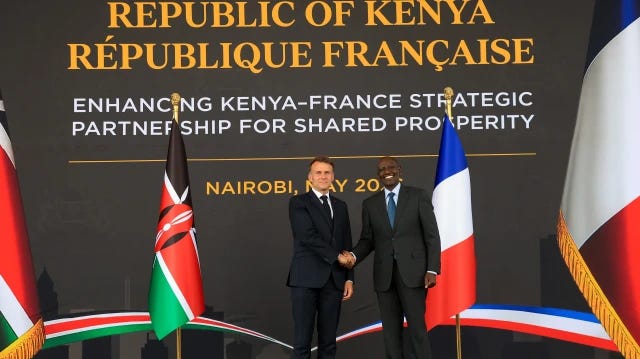
This is a busy week in global development. Today, Presidents William Ruto of Kenya and Emmanuel Macron of France will preside over the Heads of State day of the Africa Forward Summit at the Kenyatta International Conference Centre in Nairobi — a summit intended to showcase the growing partnership between the two countries, with a focus on security cooperation, economic investment, and green energy. Attending are thirty heads of state and government leaders, as well as four thousand delegates, including two and a half thousand business leaders, and by the close of today’s deliberations, the phrase “renewed partnership” will have been repeated many times, a diplomatically worded communiqué will have been drafted promising stronger collaboration, and the usual powerful photographs will have been taken.
At the same time, here in Paris, the OECD is in the second day of its conference on The Future of International Development Co-operation, where senior political leaders and policy makers, development cooperation diplomats, thought leaders, private sector players, and civil society actors from across the world have been gathering to discuss what comes next. Across the city, ODI Global has been convening the fifth and final round of its Donors in a Post-Aid World dialogues under the title What Now? Moving from Dialogue to Decisions — the closed-door session was on Sunday at the UK Embassy and the breakfast with the OECD’s Development Co-operation Directorate was yesterday morning, and I am writing this from in among those conversations. In March, Foreign Affairs published Landry Signé’s Africa After Aid, in which he argues that the cuts have revealed the continent’s economic resilience rather than its fragility, and Devex opened the year with a long piece by Raj Kumar titled The old aid model is dead. Now comes the fight over what replaces it. The whole sector, it seems, is in the same conversation at the same time.
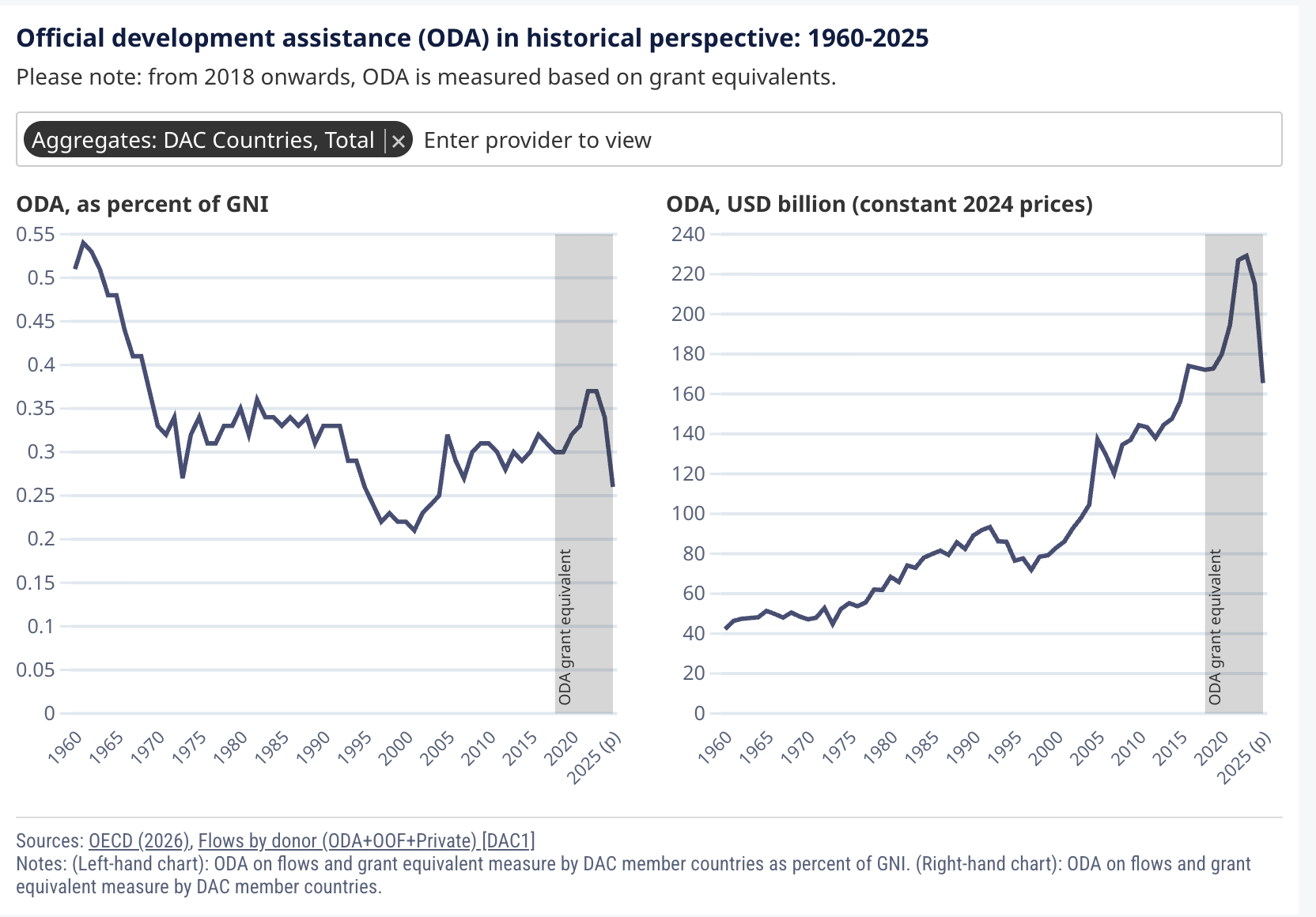
The numbers that frame this conversation came in from the OECD in April. Aid fell by 23.1 per cent in 2025 — the largest single-year drop ever recorded — taking total ODA back to its 2015 level of $174.3 billion, and aid to sub-Saharan Africa fell by 26.3 per cent. The United States cut its aid by 56.9 per cent in twelve months and on its own accounted for three-quarters of the global decline, while Germany has now become the largest donor in the world at $29.1 billion, for the first time in history. A further fall of 5.8 per cent is forecast for 2026, which is to say that the contraction is real, and it is not yet finished.
The phrase everyone keeps reaching for is “post-aid era,” and I want to suggest that it is not quite the right phrase, because an era is not best defined by the absence of someone else’s money, and what we are actually entering, it seems to me, is a post-pretence era. The pretence was that aid was the substance of the relationship between the North and the rest of us; the substance, as it turns out, was always the people doing the work.
II. What the North can let go of.
The first thing is the civilising posture in its modern dress, by which I mean the underlying geometry that has held across every successive vocabulary of cooperation — the colonial era spoke of bringing light, the development era spoke of bringing institutions, the impact era spoke of bringing results, and so the vocabulary keeps changing while the geometry, in which the North arrives with the design, we provide the site, and any failure of fit is read as a failure of the site, does not. That geometry is what needs to change, and the moment to change it is now, while the instruments that held it in place are being rebuilt anyway.
The second is the conditionality reflex, by which I mean the habit of arriving with conditions arranged in tidy packages — fiscal discipline, market liberalisation, anti-corruption, gender targets, climate safeguards — each of which is defensible on its own terms but which, stacked together, amount to a foreign policy template that recipient countries did not arrive at through their own democratic processes. There is a more honest version of this conversation available, one in which values are advanced through persuasion, partnership, and example rather than through financial leverage, and that version is where I would like to see the sector move.
The third is the legibility demand, which is to say the architecture’s insistence that African institutions become legible — through legible budgets, legible logframes, legible indicators, legible procurement, legible beneficiaries — before they are permitted to participate. While legibility has a real purpose, it also carries a real cost, because whole African ministries now bend their calendars around donor reporting cycles and whole categories of African organisations exist primarily to be legible to people in Berne and The Hague, which is to say that the cost has become disproportionate to the purpose, and the system is overdue for a renegotiation of that balance.
And then there is the larger point, which is that aid was never really separate from the rules, because the same governments now scaling back ODA also shape the global tax architecture, the intellectual property regimes, the sovereign debt processes, and the trade rules under which the rest of us operate. Writing in AfricaBrief in March, Lyla Latif set out a careful line-by-line comparison between the October 2025 and January 2026 drafts of the UN Framework Convention on International Tax Cooperation, and her summary of what she found was that “strong language gets weaker, binding commitments become aspirational suggestions, and specific obligations dissolve into vague processes.” She gives the example of Article 8 on harmful tax practices, where the October draft required tax incentives to be “substance-based, linked to investment or performance, and not merely profit-based” — language that simply vanished from the January draft and was replaced with softer references to “developing, enhancing and implementing effective tools” and “monitoring and identifying emerging harmful tax practices” — and she notes that on Article 6, on the taxation of high-net-worth individuals, the obligation shifted from “shall adopt coordinated approaches” to “shall explore coordinated approaches,” which she describes as “the difference between enforceable commitment and political theatre.” This is happening now, in the same season as the conferences about the future of cooperation, and a post-aid era that leaves the rules untouched leaves the harder work undone. The opportunity, for the partners in this conversation who are serious, is to do that harder work alongside the conversation about aid itself.
III. What we can let go of.
The first thing is the performance of grievance, and I want to be careful here because the historical case is overwhelming and does not need to be relitigated in this essay — conquest happened, extraction happened, structural adjustment happened, the asymmetry persists — and these are the diagnosis, not the prescription. The trouble is that grievance, when it is performed and re-performed without being converted into work, produces nothing on its own, and it has become, in some quarters of our intellectual life, the African thinker’s principal export, which is to say that we quote Fanon at conferences without doing the work he would have recognised as work, and we invoke Sankara on stage in three-piece suits before flying out on diplomatic passports, and the next chapter of this story has to ask more of us than that.
The second is the theatre of dependence, by which I mean that quiet, well-rehearsed performance, repeated in capital after capital, in which we arrive at international tables ready to recite our limitations before our offers, our deficits before our designs, and our gratitude before our positions. It is a posture inherited from a relationship in which our role in the room was to be supplicants, and it has now outlived the relationship that produced it, persisting in the way we open speeches, in the way we draft communiqués, and in the way our negotiators are briefed to manage rather than to lead. The cost of the theatre is not just dignity but also leverage, because people who arrive at a table appearing to need it cannot negotiate its terms, and the next chapter of African engagement with the world needs negotiators, ministers, and presidents who walk in carrying offers rather than asks.
The third is what I have come to think of as the Davos posture, by which I mean the deference to external credentialism among too many of our elites that has become, I think, one of the most expensive psychological infrastructures we still maintain — a Harvard fellowship, a Munich invitation, a TED stage, a Brookings paper, which we treat in too many of our rooms as the validation that confirms an African is finally serious. The result is that some of the most consequential builders on this continent in the last thirty years have done their work without any of those credentials, while some of the most decorated African experts on Africa have built less than the work would suggest, and the deference, which is colonial residue, is something we can begin to let go of by hiring, funding, board-seating, and quoting our own theorists, our own builders, and our own institutions, without apology and with confidence.
The fourth is what we might call the local NGO subcontracting question, because many of our civil society organisations are not, in any structural sense, African — they are nationally registered subcontractors to Northern funders, with mission statements, theories of change, and reporting calendars dictated by the funder’s logframe, and when USAID was dismantled at the start of last year, the panic that followed across this sector was itself the diagnosis. Ten years after the Grand Bargain pledged twenty-five per cent of humanitarian funding to local and national groups, the figure sits at around 4.5 per cent, which is to say that the redistribution that was promised did not happen on its own and is unlikely to happen in the next architecture without us building it ourselves. A serious African civil society needs financing that survives the loss of any single funder, and the architecture for that financing — diaspora capital, faith institutions, professional associations, cooperatives, member dues, social enterprise revenue, and domestic philanthropy — is local, and while none of those sources is easy, all of them are real.
The fifth is the leak that rarely gets named from the main stage at these summits, and that I want to name here. Africa loses somewhere between fifty and ninety billion dollars a year to illicit financial flows — the African Union’s own figure sits at around fifty billion — and a meaningful share of that is not foreign multinationals shifting profits but wealth that originates on the continent and exits it, into London, Geneva, Dubai, and the offshore archipelago, often through legal vehicles and intermediaries to which the same African voices calling for reparations are themselves personally connected. We cannot build a fiscal contract between our states and our citizens on revenues that are being moved offshore by the very people negotiating that contract, and we have to begin to apply the standards we have asked of Northern donors to ourselves.
And the sixth is the conference habit itself, the irony of which is not lost on me as I write this from Paris on the day of a summit in Nairobi and an OECD gathering happening here in this same city. We have arrived at a place where Africans, having grown weary of being summoned to summits in Paris and Brussels and London to discuss our continent, now convene our own summits in Nairobi and Kigali and Addis and invite the Europeans, and this is progress — but it is not yet sufficient, because the family meeting still needs to happen before the neighbourhood meeting, and the deeper question is whether we are using these gatherings to coordinate the work among ourselves or to perform the existence of the work for audiences whose attention is, in any case, drifting. There is a version of a summit that produces decisions, deadlines, and money, and there is a version that produces a communiqué — and the first is the one worth our time.
IV. What we should lean into.
Before I come to what is being built, I want to make the case for what we should be designing around, because much of what comes next depends on whether we are willing to take our own cultural and economic practices seriously enough to architect public policy around them rather than around their imagined Northern replacements.
The chama, the iddir, the tontine, the boda-boda network, the trader association, the apprenticeship system, the rotating savings group, the church welfare fund, the WhatsApp lending circle and the dozens of other institutions through which African economic life actually functions are not way stations on the road to a more “formal” economy that one day resembles a Northern one — they are the form, and they move enormous volumes of value while holding hundreds of millions of households through volatility that would crush a comparable Northern middle class. M-Pesa was not invented to replace the chama; it scaled precisely because the chama was already there, and the most successful African financial technologies of the last twenty years have been those that read the existing architecture correctly rather than those that tried to overwrite it.
The implication of this, which I think we have been slow to draw, is that the next generation of African economic policy — on credit, on insurance, on social protection, on pensions, on health financing, on tax, on housing — should begin not with imported templates and then look for ways to make them fit, but with the institutions our people already use, trust, and operate, and should then design outwards from there. That means pension systems that integrate with rotating savings groups rather than displace them with mandatory schemes that millions cannot afford to participate in, health financing systems that work with the welfare funds attached to churches, mosques, and burial societies rather than pretend those institutions do not exist, credit systems that recognise the credit histories embedded in chamas and trader networks rather than require borrowers to invent paper credentials they will never possess, and apprenticeship economies that are regulated and resourced rather than formalised out of existence. The opportunity, which we have not yet seized at the scale it deserves, is to architect African modernity outwards from African practice rather than to keep apologising for the gap between the two.
V. What is being built.
While the world has been preparing communiqués, things have quietly been built, and it is worth spending a moment with them.
The Pan-African Payment and Settlement System now connects more than 160 commercial banks across twelve African countries, and in February of this year, Pesalink linked another eighty Kenyan banks, fintechs, SACCOs, and telcos into the network, which means that payments that used to take a week and cost seven per cent now take two minutes and cost a fraction of that, and that an African no longer needs a dollar to pay another African. That is what infrastructure sovereignty looks like in practice.
The African Continental Free Trade Area has now been ratified by 49 of 54 signatories, and in February, at the AU Assembly in Accra, heads of state inaugurated a continental implementation committee chaired by President Ruto, along with 8 new annexes to the Intellectual Property Rights Protocol. The architecture is largely in place, and what remains is the work of making it function — which is, finally, the work our political class was elected to do.
The UN Framework Convention on International Tax Cooperation entered its fourth substantive negotiating round in New York in February, chaired by Egypt’s Ramy Youssef, and the most consequential rewriting of the global tax architecture since the 1960s is now being negotiated under African insistence. The question of our fiscal sovereignty for the next generation will be settled in that room as much as anywhere else, and we have both the chair and the Africa Group, which means the work, for now, is to hold the position while much of the rest of the sector is absorbed in its own transition.
Remittances to low- and middle-income countries reached nearly seven hundred billion dollars in 2024, growing by ten per cent, roughly four times the total of DAC ODA in 2025 — making this the largest people-funded support flow in the modern world. We built it without permission, without a logframe, and without a Geneva committee; we built it because we had to. We still do not own the rails, however, and we pay around seven per cent of every transaction to a handful of Northern remittance companies, which means that the rails are the next thing to build.
The African Development Bank, under new leadership, has raised billions in new capital from Gulf states and is, for the first time, issuing bonds to fund its concessional lending, and in January it held its first joint sit-down with the Arab Coordination Group in Abidjan, which means that Arab capital is now being deliberately positioned as a central pillar of our development financing and the diversification is happening — though the question is whether we will negotiate the same terms from Gulf, Asian, and BRICS partners that we were not always able to negotiate from Northern ones, and the answer to that question depends on whether post-pretence is also post-deference.
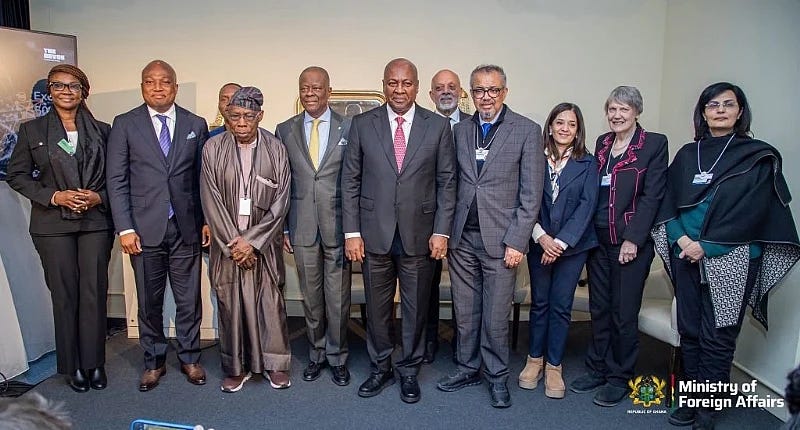
And then, in Accra, a doctrine has formed, which I would like to spend a little time with. The Accra Reset, anchored by President Mahama and convened with a Guardians’ Circle that includes Olusegun Obasanjo, Ellen Johnson-Sirleaf, John Kufuor, and Helen Clark — with Sidi Ould Tah of the African Development Bank representing the continent’s multilateral financial institutions — was unveiled at UNGA in September, took shape at Davos in January, and scaled at the February AU Summit with three formal launches: a sovereign financing facility, a Global Digital Skills Passport roadmap, and a Sovereign Negotiators Network. Its proposition is short and worth quoting in full: Sovereignty is not a slogan. It is a discipline of delivery. The Reset names three burdens — geopolitical vulnerability, donor dependence, and geostrategic marginalisation — and treats them as one design problem, and it runs a public Action Ledger so that commitments made in convening rooms are tracked against delivery milestones. The dialogue this week in Paris asks What Now? — and there is, in fact, an answer forming, and it is being built in Accra.
VI.
To the policymakers, business leaders, and development professionals who are in Nairobi today, and to those of us in Paris this week, at the OECD and at the dPAW:
The communiqué is not the point, and neither are the handshake photographs or the keynote applause — the point, as it has always been, is the work, by which I mean the fiscal, the technical, and the deeply political work of building the contracts and the rails and the institutions that will hold us when the next external assurance changes. And it will change, because the composition of Northern political support has always been a function of Northern politics, and Northern politics, like all politics, shifts. We have, finally, learned this, and we should not have to learn it again.
The development industry’s mistake, like that of many institutions in transition, has been to confuse the end of its instruments with the end of the work — but the work has always been done by the people in whose name the instruments existed, and so the instruments are changing while the work continues.
The aid is dead. We can talk now.
And when the speeches end — in Nairobi, in Paris, in whichever city the calendar throws up next — the question is no longer what now, but how fast.
Excellent and well-articulated. Thank you for writing and sharing this.