

Who do you know?
How Africa actually works, and what that asks of AI

A Kenyan needs something done. A bed in a good hospital, a file moved at the Lands office, a place for a child in a school that filled up months ago. Before any form is filled, one question settles the matter: who do you know there? We reach for a cousin, an old classmate, the neighbour’s son who works in the right building. Every formal system in this country keeps a front door for the public and a second door that opens to a name, and the second door is the one that moves. That is the real thesis here: we have organised our public life around the quiet knowledge that a relationship travels faster than a procedure.
That second door is the informal economy, and it runs through every ministry, every bank, every institution we built to operate on rules. The International Labour Organisation estimates that around 85 per cent of employment in Africa is informal. The AUDA-NEPAD white paper on AI and the future of work puts it at 85.8 per cent, with as many as 95 per cent of young people aged 15 to 24 earning their living this way. These numbers describe the ground we stand on. In other words, the informal economy is the African economy, and the salaried few live inside it with everyone else.
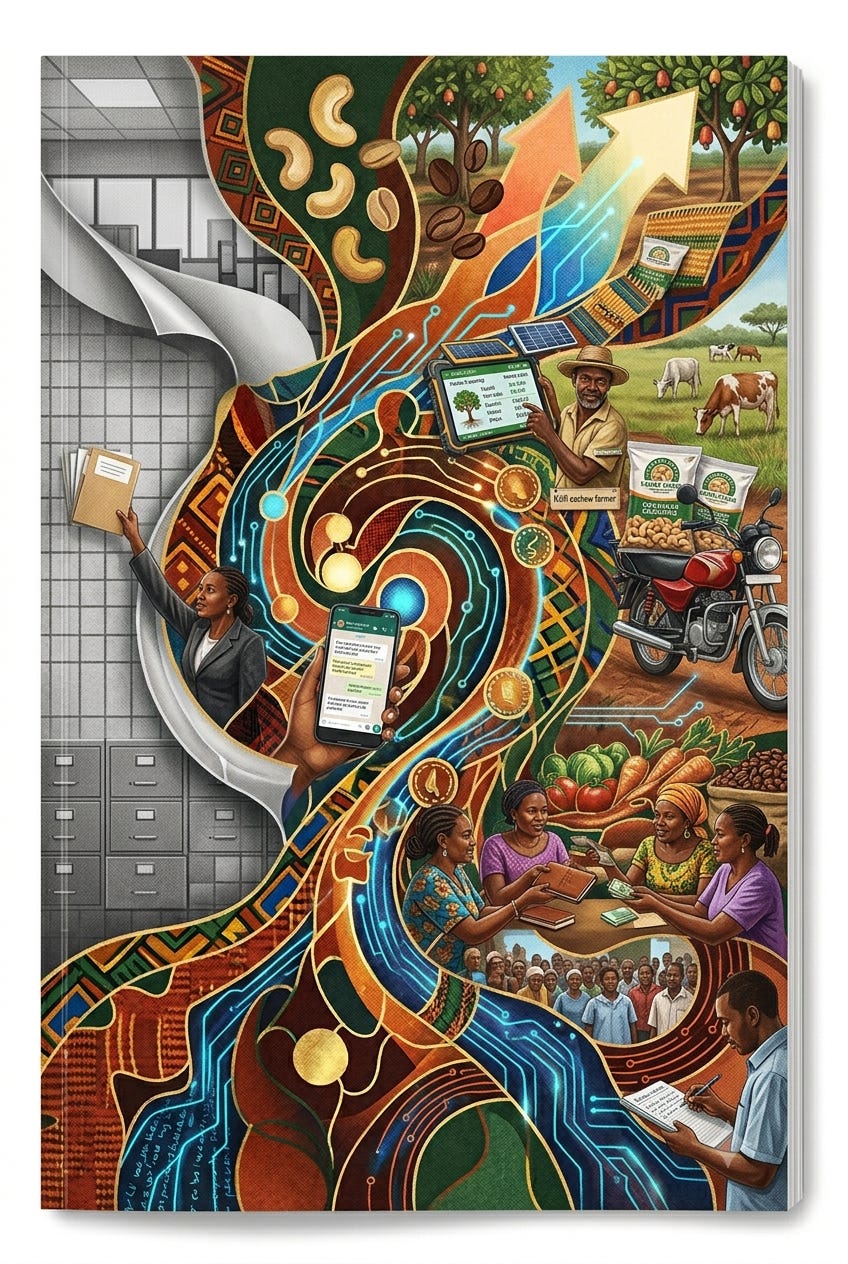
Watch a civil servant with a government payslip. She sells plots on WhatsApp in the evenings, keeps a few cows back in shags, and pays into a chama with eleven other women every month. That chama is her real pension. When her father dies, a harambee raises the cost of the funeral over a single weekend, recorded in a school exercise book and settled in cash. The contract and the chama sit in the same life, and she crosses between them all day with the border invisible beneath her feet.
This way of working is its own architecture, with its own rules of evidence. A young man learns to be a fundi at the elbow of an older one, earning as he learns. A trader’s credit is her name in the market, remembered and enforced by everyone who buys and sells there. Money moves through groups that pool, witness, and lend on the strength of people knowing one another — the chama in Kenya, the stokvel in South Africa, the esusu among the Yoruba, the tontine across the Sahel, one continental design wearing a dozen names. It is quick, it is cheap, it runs on trust, and it has carried this continent for longer than any bank has stood on it. So when formal systems fail to explain daily life, these networks do the work.
Artificial intelligence now walks into this life, and its value depends on how well it fits into the life already here.
To be of use to the mama mboga or the boda rider, it has to speak the way they speak — Kiswahili and Sheng, Giriama and Luo, the cadence of a Gikomba haggle, the shorthand of a WhatsApp group, the who-knows-whom logic that closes real deals. Our two thousand languages are the richest raw material we hold for this work; they are to artificial intelligence what cobalt is to a battery, and the model that learns them serves a billion people who think in them. The same model has to read our institutions as the working things they are: the chama as a lender, the harambee as insurance, the apprenticeship as a qualification, a good name in the market as a credit score.
Then comes the real prize. AI earns its keep here by raising the value of what people already make. A cashew farmer in Kilifi sells raw nuts to a broker who carries the real money downstream, to whoever grades, roasts, packages and brands them. An AI that knows his trees, his rainfall and his market helps him grade his crop, price it, reach the buyer three counties over, and sell roasted and salted nuts in a bag that carries his own name. The women down the road who process coconuts make the same climb, and so do the jua kali welder and the weaver. The payoff is more value kept by the producer. In this way, the technology turns production into a path upward.
This is the oldest African story told at a new scale. We dig cobalt and ship it raw, and it comes back to us as a battery sold at the finished price. We let our data be scraped for nothing, and it comes back as software we rent by the month. The farmer selling raw nuts to a broker is the same arrangement drawn small, in one village, around one crop. The work at every scale is to take the value chain apart node by node and keep more of each node in African hands — the roasting, the packaging, the brand, the price. The continent does it with its minerals and its mother tongues; the farmer does it with his trees. AI that understands the chain is how the small producer finally climbs it and keeps more of the return.
The growth this builds comes from the many. It is millions of small producers, each capturing one more rung of their own value chain — the roasting, the packaging, the price — all at once, in every market, roadside, and workshop on the continent. Add those small climbs together, and the figure is enormous, and it stays at home. The scale is already proven. Kenya’s SACCOs hold over a trillion shillings among roughly seven million members. Chamas move close to a third of the country’s economy through savings and lending that no ministry designed and no bank built. South Africa’s stokvels turn over tens of billions of rand each year. Taken together, a disaggregated economy of this kind compounds from a million decisions and steadies itself, because its strength is spread across the many and held by no single hand that can drop it.
AI built in our languages, fluent in our relationships, and pointed at the price the farmer gets is the tool that lets a million of those climbs happen at once. We already do the work. With that tool, the work accelerates.